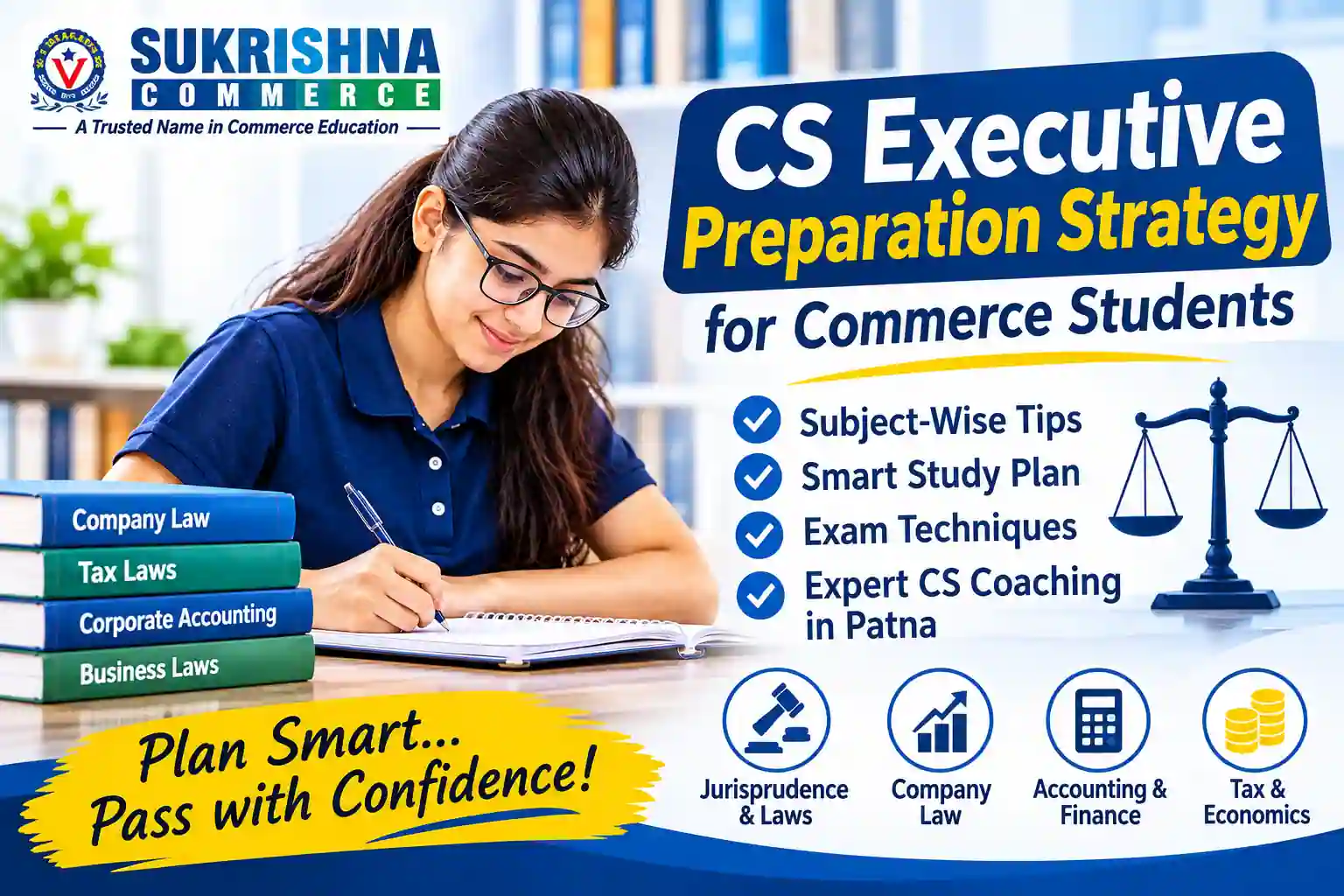
Clearing your CSEET entrance test feels like a huge victory, doesn't it? For a couple of days, you are on top of the world—until the courier boy rings your doorbell and hands you a giant, heavy box of official ICSI study modules! Suddenly, the real challenge of CS Executive preparation stares right back at you. While CSEET was a friendly computer test with multiple-choice questions, the Executive stage is a serious professional exam where you have to write deep legal answers, decode corporate laws, and calculate complex taxes by hand.
The wonderful news is that if you come from a commerce background, you already hold a massive secret advantage! Knowing how commerce students can prepare for CS Executive by connecting your school Accountancy, Business Studies, and Economics basics to corporate law makes the whole journey twice as easy. Instead of memorizing thick books blindly, following a smart CS Executive preparation strategy and joining structured CS Executive coaching turns scary legal sections into exciting real-world business stories. With expert mentorship from Sukrishna Commerce Academy—widely trusted as the Best CS Coaching in Patna—you can master both groups smoothly, sharpen your legal writing skills, and pass your exams on the very first try!
Before creating your CS Executive study plan, you need to look closely at what the Institute of Company Secretaries of India (ICSI) actually tests. The CS Executive curriculum is divided into two groups (Modules) containing seven comprehensive papers of 100 marks each.
Unlike earlier years, when some papers were purely objective, the current ICSI syllabus follows a combination of 80% descriptive (subjective writing) and 20% case-based objective questions across most papers (except Paper 4, which has its own specific numerical and practical structure).
To pass a group, you must score a minimum of 40% marks in each individual paper and at least 50% aggregate marks across all papers in that group combined.
Many students feel scared when they see the word "Law" in almost every subject title. However, effective Company Secretary preparation is not about becoming a courtroom criminal lawyer; it is about becoming a corporate governance expert! As a commerce student, you already understand how businesses work:
Paper 4 (CAFM) Is Your Home Ground: In Class 12 and B.Com, you already studied Issue, Forfeiture, and Redemption of Shares, Debentures, Cash Flow Statements, and Financial Ratios. Paper 4 in Group 1 lets you score 65 to 75+ marks easily, lifting your entire Group 1 aggregate!
Familiarity with Company Law Basics: You have already read about Memorandum of Association (MoA), Articles of Association (AoA), Prospectus, and Directors in Class 11 and 12 Business Studies.
Understanding Stock Markets & Finance: Concepts like SEBI, primary markets, secondary markets, and Foreign Exchange (FEMA) connect directly to your school Economics and Business Finance chapters.
One of the biggest questions during CS Executive preparation is deciding whether to sit for one module at a time or appear for both modules together in June or December.
When to Choose Both Groups Together: If you have at least 9 to 11 months before the exam, are not working a full-time job, and start your Sukrishna CS coaching early, targeting both groups gives you two huge benefits: you get the set-off advantage (if you score 55% in Group 1 and 45% in Group 2, your combined 50% average helps you pass both!), and you become eligible for top All-India Ranks.
When to Choose a Single Group: If you have less than 5 to 6 months left before the exam, or you are managing regular college exams alongside coaching, picking Group 1 first is the smartest, safest strategy. Focusing on just four subjects ensures solid conceptual clarity without mental burnout.
Because CS Executive combines pure theory laws with heavy numerical subjects, you cannot study every paper the same way. Follow this three-bucket approach:
Company Law (Paper 2) and Securities Laws (Paper 5) are the backbone of your future career as a Company Secretary.
Treat the ICSI Module as Your Bible: Never rely only on thin shortcut summary books. Examiners frame tricky case-law questions directly from paragraphs inside the official ICSI study material.
Focus on Sections and Procedures: You do not need to memorize all 470 sections of the Companies Act! Focus on the 60 to 70 most repeated sections—such as Incorporation, Board Meetings, Annual General Meetings (AGM), Corporate Social Responsibility (CSR), Deposits, and Directors' qualifications.
Make Flowcharts for Compliance Limits: Corporate law is full of time limits (like "within 30 days of passing a special resolution") and paid-up capital limits. Draw colorful flowcharts on chart paper and stick them on your bedroom wall for daily viewing.
For commerce students, Corporate Accounting & Financial Management (Paper 4) and Tax Laws (Paper 7) are the ultimate aggregate boosters!
Daily 90-Minute Practice: Never treat Accounts, Financial Management, Income Tax, or GST like reading subjects. Solve at least 5 to 8 practical numerical problems in your notebook every single day.
Master Working Notes and Formats: In subjective accounting and tax papers, step marks matter. Always draw clean formats and show clear working notes underneath your main answer.
Stay Updated on Finance Act Amendments: For Tax Laws (Paper 7), always check the latest tax slabs, GST notifications, and ICSI statutory updates applicable for your specific June or December exam session.
Papers 1 and 6 have a wide syllabus containing 15 to 18 separate legal acts each (such as the Law of Torts, Indian Stamp Act, Arbitration Act, Consumer Protection Act, and Trademarks).
Follow the ABC Priority Rule: Divide the chapters into Category A (high-weightage chapters asked in every attempt), Category B (moderate chapters), and Category C (short, easy chapters). Finish Category A and C first to lock in 70% of the paper!
Why do some students study twelve hours a day and still get stuck at 38 marks in Company Law? Because they write answers like a college BA exam instead of a professional legal paper! In CS Executive, how you write matters just as much as what you know.
Whenever you face a situational case-study question (which makes up most of the paper), always write your answer in Four Clear Paragraphs:
Paragraph 1 – Legal Provision: Start strictly with the law. Write: "As per the provisions of Section [Number] of the Companies Act, 2013..." (If you do not remember the exact section number, never guess a wrong number! Simply write: "As per the relevant provisions of the Companies Act, 2013...").
Paragraph 2 – Facts of the Case: Briefly summarize the story given in the question in 2 to 3 simple lines to show the examiner you understood the problem.
Paragraph 3 – Analysis & Application: Connect the legal rule from Paragraph 1 with the story in Paragraph 2.
Paragraph 4 – Final Conclusion: Give a crisp, one-line verdict (for example: "Hence, the appointment of Mr. Sharma as an Independent Director is invalid.").
Consistency beats late-night cramming every single time. Here is a balanced CS Executive study plan that pairs one heavy law paper with one practical numerical paper every day:
Morning Slot (06:30 AM – 09:00 AM): Core Law Study (Company Law / CMSL) Your brain is freshest in the morning. Read new legal provisions, understand sections, and make short bullet notes.
Mid-Morning / Day (10:00 AM – 02:00 PM): Coaching Classes & Doubt Clearing. Attend your regular Sukrishna CS classes Patna lectures actively and highlight important classroom examples.
Afternoon Slot (03:30 PM – 05:30 PM): Practical Numericals (CAFM / Tax Laws). After lunch and a short rest, solving Accounts, Financial Management, or Tax calculations keeps you wide awake and active.
Evening Slot (06:00 PM – 08:00 PM): General Laws (JIGL / SBILL / ECIPL) Read two smaller acts, practice framing legal answers in your rough register, and review procedural flowcharts.
Night Slot (09:15 PM – 10:30 PM): Daily Writing Drill & Past Paper Review Write out at least two full descriptive answers by hand from previous year ICSI question papers (scanners) before going to sleep.
Preparing for a rigorous professional course like CS Executive on your own can quickly feel lonely and confusing. Decoding thick legal bare acts, keeping track of quarterly ICSI amendments, and learning professional answer presentation requires experienced mentors who have guided hundreds of toppers.
This is why commerce students across Bihar trust Sukrishna Commerce Academy. Celebrated as the Best CS Coaching in Patna, our institute provides a complete, student-friendly ecosystem designed specifically for Company Secretary aspirants.
When you enroll in Sukrishna CS coaching, you gain an unbeatable academic advantage:
Expert CS & CA Faculty Team: Learn Company Law, Securities Law, Taxation, and Corporate Accounting directly from qualified Company Secretaries, Chartered Accountants, and legal experts who turn boring sections into unforgettable real-life stories.
ICSI Module + Scanner Coverage: Our Sukrishna CS classes Patna cover 100% of the official ICSI study modules alongside the past 10 years' solved scanner questions right inside the classroom.
Dedicated Legal Writing Workshops: We do not just teach theory; we check your handwritten notebooks! Our teachers train you step-by-step on the 4-paragraph legal answer format, legal vocabulary, and time management.
Regular Chapter-Wise & Full Mock Tests: Before you sit for the final ICSI exam, you write multiple 3-hour mock papers under strict exam hall conditions, getting line-by-line feedback on where to improve your marks.
Timely Amendment & Revision Marathons: We conduct special revision classes covering all the latest ICSI statutory updates, Finance Act changes, and one-day-before-exam marathon sheets so you walk into the exam center with 100% confidence.
Stepping onto the path of Company Secretary preparation opens the door to one of the most respected boardroom careers in corporate India. By using your commerce strengths in Accounting and Taxation, building a structured CS Executive study plan, and practicing daily legal answer writing, conquering CS Executive preparation becomes a smooth, rewarding milestone. Do not let heavy books or self-doubt slow down your journey. Connect with Sukrishna Commerce Academy today, join the most trusted Sukrishna CS coaching batch in Bihar, and let our expert mentors guide you straight to your dream "CS" prefix!
CS Executive is challenging because of its vast legal syllabus, not because the concepts are impossible to understand. An average commerce student who studies consistently for 6 to 7 hours daily, leverages their strong Accountancy and Tax basics, and practices writing legal answers can easily clear the exam on the first attempt.
No, ICSI does not deduct marks if you do not quote a section number, as long as you write the correct legal provision clearly. However, quoting a wrong section number leads to an immediate zero for that question! Only write section numbers when you are 100% sure.
While classroom notes are wonderful for quick revision, reading the official ICSI Study Material at least once is mandatory. ICSI examiners often pick a single line from the middle of a module chapter to create a 5-mark case study.
You should aim for at least three complete revisions alongside solving at least two full-length mock test papers per subject before your June or December attempt.




Copyright 2020-26 All Rights Reserved by Sukrishna Commerce Academy. Desgined by Shish Technology



 info@sukrishnacommerce.com
 +91-8051000032











 Download Brochure