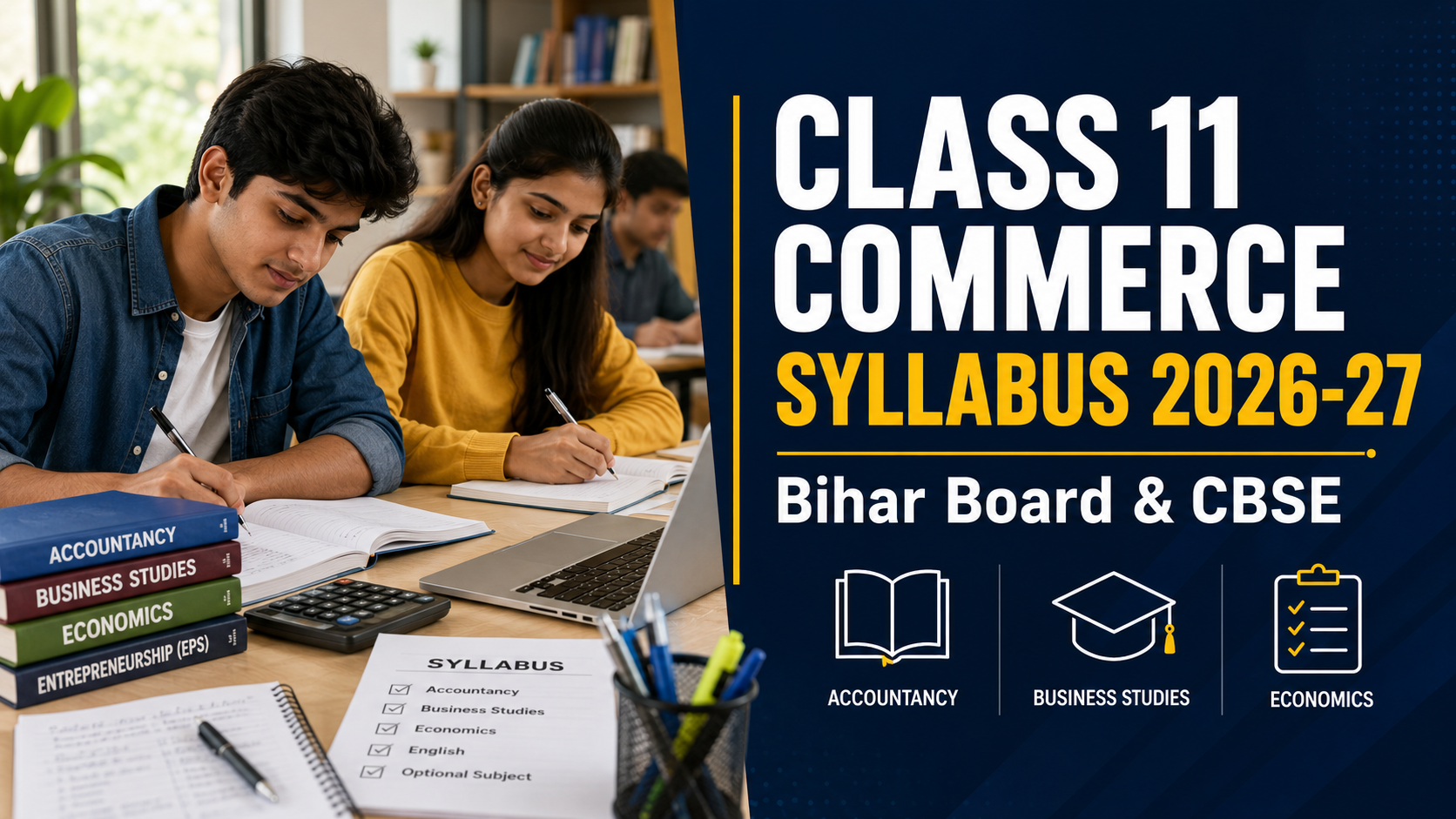
Moving from class 10 to class 11 is a very big change in your student life. You are finally leaving behind general science and history to enter the modern world of business, money, and banking. Taking the commerce stream is a great choice for your future career. It opens big doors for you to become a Chartered Accountant (CA), a rich business owner, or a smart bank manager. But before you go to the market to buy books or start reading notes, finding the right class 11 commerce syllabus 2026-27 is your first and most important step today.
If you study the wrong chapters or old topics, you will just waste your precious time and energy. It does not matter if you go to a central board school or a state board school. Knowing your exact study topics will make your final school exams very easy. In this very simple and helpful guide, we will provide the complete class 11 commerce syllabus 2026-27 Bihar Board CBSE for you. We will explain all the subjects in very simple words. This will clearly help students and their parents understand exactly what to expect this year without any mental confusion.
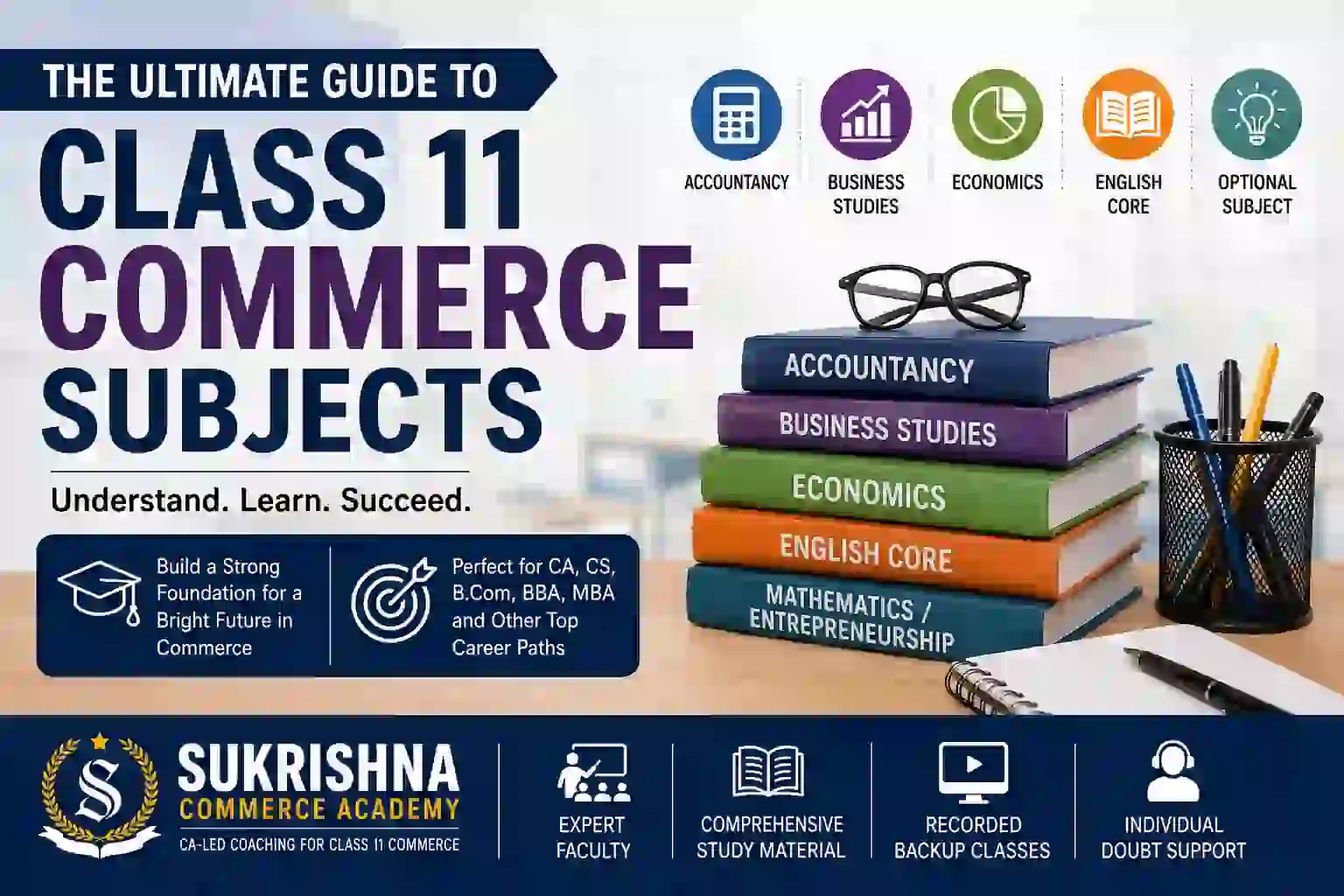
Before we look at the specific rules for different boards, you must clearly understand that both boards share three main subjects. These three subjects are the basic foundation of commerce. If you master these three, your entire journey will be very smooth and highly enjoyable.
The Central Board of Secondary Education updates its study rules to make them modern. The CBSE syllabus is strictly based on real-world case studies. Here, you must study five main subjects: three core subjects, one compulsory language paper, and one optional paper.
Here is the exact simple breakdown:
The CBSE Accountancy paper focuses on basic counting concepts.
English is completely mandatory. For your fifth subject, CBSE offers choices like Mathematics, Physical Education, or Computer Science.
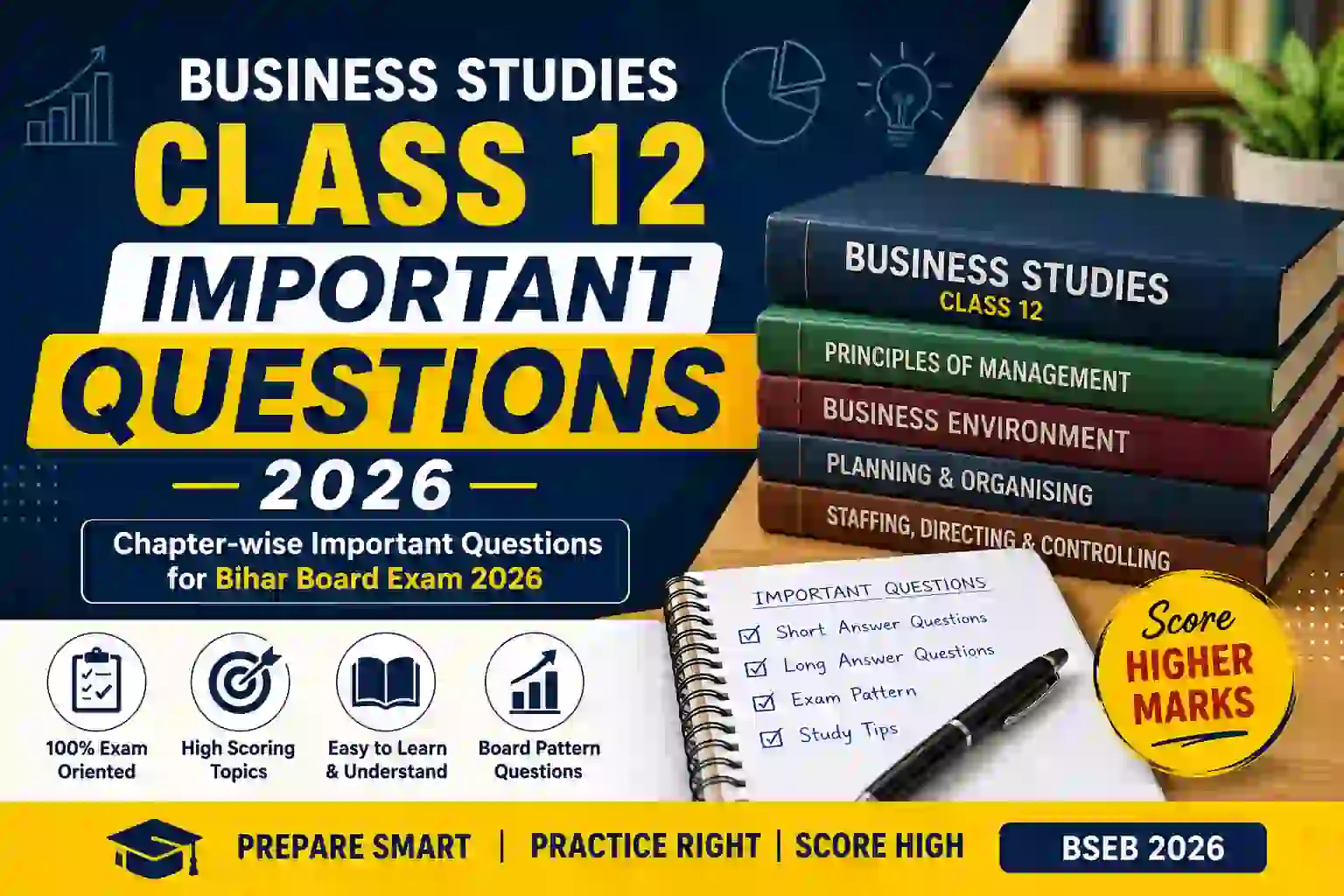
The state board structure is slightly different. The Bihar School Examination Board (BSEB) puts a massive focus on objective questions. In your final exams, 50% of the questions will be Multiple Choice Questions (MCQs) filled on an OMR sheet. This makes the Bihar Board syllabus commerce very scoring and easy.
Here is the exact simple breakdown:
The book chapters are identical to the central board. You will learn the exact same Journal, Ledger, and Final Accounts. However, the exam pattern is different. You will face 50 objective questions of 1 mark each. The remaining 50 marks are for short and long written theory answers.
Just like Accountancy, the Business Studies chapters match perfectly. Again, the final exam will heavily feature 50 marks of direct MCQs, making it easy to pass with high grades.
Students have a special choice here.
You select two main language papers, like Hindi (100 Marks) and English (100 Marks), focusing on basic grammar.
Class 11 forms the absolute base for your future Class 12 board exams. If your base is weak today, Class 12 will become very tough tomorrow. Follow these simple daily tips to stay ahead of your class:
Entering a new stream is highly exciting, but studying without a proper plan can cause heavy stress before exams. Understanding the correct books and chapters is your first major victory. When you fully understand the class 11 commerce syllabus 2026-27, your study planning becomes totally stress-free. By carefully knowing what chapters to read, you can safely stay ahead of your school teachers.
To cover your entire course smoothly and completely on time, you absolutely need expert teachers who simplify tough concepts. Joining the highly structured Sukrishna Commerce Academy syllabus completion program is the absolute best decision for a new student. They provide extremely simple printed notes, friendly teachers, and conduct weekly tests to remove all exam fear. Start your bright journey today!
No, mathematics is not compulsory in either board. In CBSE, it is offered as an optional elective alongside choices like Informatics Practices, Physical Education, or Fine Arts. In the Bihar Board, students also have choices and frequently opt for Entrepreneurship (EPS) or Economics instead of mathematics.
The three main foundational subjects for both the CBSE and Bihar Board commerce streams are Accountancy, Business Studies, and Economics. English is also a mandatory language subject across both educational boards.
While the core textbook chapters are nearly identical, the final exam structures differ significantly. The Bihar Board places a massive focus on objective questions, with 50% of the exam consisting of Multiple Choice Questions (MCQs) to be filled on an OMR sheet. In contrast, CBSE focuses more on long theoretical answers, real-world case studies, and a 20-mark internal project assessment.
EPS stands for Entrepreneurship. It is a highly popular optional subject specifically for Bihar Board students that focuses on the practical skills needed to launch, finance, and successfully manage a startup or new business venture.
Educational boards periodically update their syllabi to align with new national curriculum frameworks. You should always download the latest official 2026-27 syllabus PDF directly from the CBSE official website (cbse.gov.in) or the Bihar School Examination Board portal (biharboardonline.bihar.gov.in) to check for any deleted chapters or modified topic weightage.




Copyright 2020-26 All Rights Reserved by Sukrishna Commerce Academy. Desgined by Shish Technology



 info@sukrishnacommerce.com
 +91-8051000032









 Download Brochure