Choosing the right career after Class 12 is one of the most important decisions in a student's life. If you enjoy subjects like Accountancy, Business Studies, Economics, Mathematics, Taxation, and Finance, then becoming a Chartered Accountant (CA) can be one of the most rewarding career choices. Chartered Accountants are among the highest-paid finance professionals in India and are respected worldwide for their expertise in accounting, auditing, taxation, financial management, and business consulting.
Every year, thousands of students dream of becoming a CA after completing their 12th. However, many students are confused about the CA course eligibility, registration process, exam pattern, fees, duration, and career opportunities. If you are also wondering how to become a Chartered Accountant after 12th, this detailed guide will help you understand every step of the journey.
Whether you are from the Commerce, Science, or Arts stream, you can pursue the CA course after Class 12 by following the guidelines prescribed by the Institute of Chartered Accountants of India (ICAI).
A Chartered Accountant (CA) is a highly qualified finance professional certified by the Institute of Chartered Accountants of India (ICAI). CAs play a vital role in managing financial records, auditing companies, preparing tax returns, ensuring legal compliance, advising businesses on investments, and helping organizations make informed financial decisions.
Chartered Accountants work across industries such as:
Banking
Corporate Companies
Government Departments
Tax Consultancy Firms
Audit Firms
Financial Institutions
Startups
Multinational Companies (MNCs)
Stock Market & Investment Firms
Due to their expertise, Chartered Accountants are always in demand in India and abroad.
The Chartered Accountancy course is one of the most respected professional courses in India. It offers excellent career growth, attractive salary packages, and opportunities to work in top organizations.
High-paying career opportunities
Globally recognized professional qualification
Excellent job security
Opportunity to start your own CA practice
Work with multinational companies
Expertise in taxation and auditing
Strong career growth in finance and accounting
Respectable profession with leadership opportunities
Students who complete the CA course successfully often secure positions in Big Four accounting firms, investment banks, consulting firms, and Fortune 500 companies.
Yes.
Students from Commerce, Science, and Arts streams can register for the CA Foundation Course immediately after passing Class 12.
However, Commerce students generally find the course easier because subjects like Accountancy and Business Studies provide a strong foundation.
To register for the CA Foundation course, students should meet the following eligibility requirements:
Must have passed Class 12 from a recognized board.
Register with ICAI for the CA Foundation Course.
Appear for and pass the CA Foundation Examination.
No minimum percentage is required for registration, but scoring well in Class 12 helps students build a strong academic base.
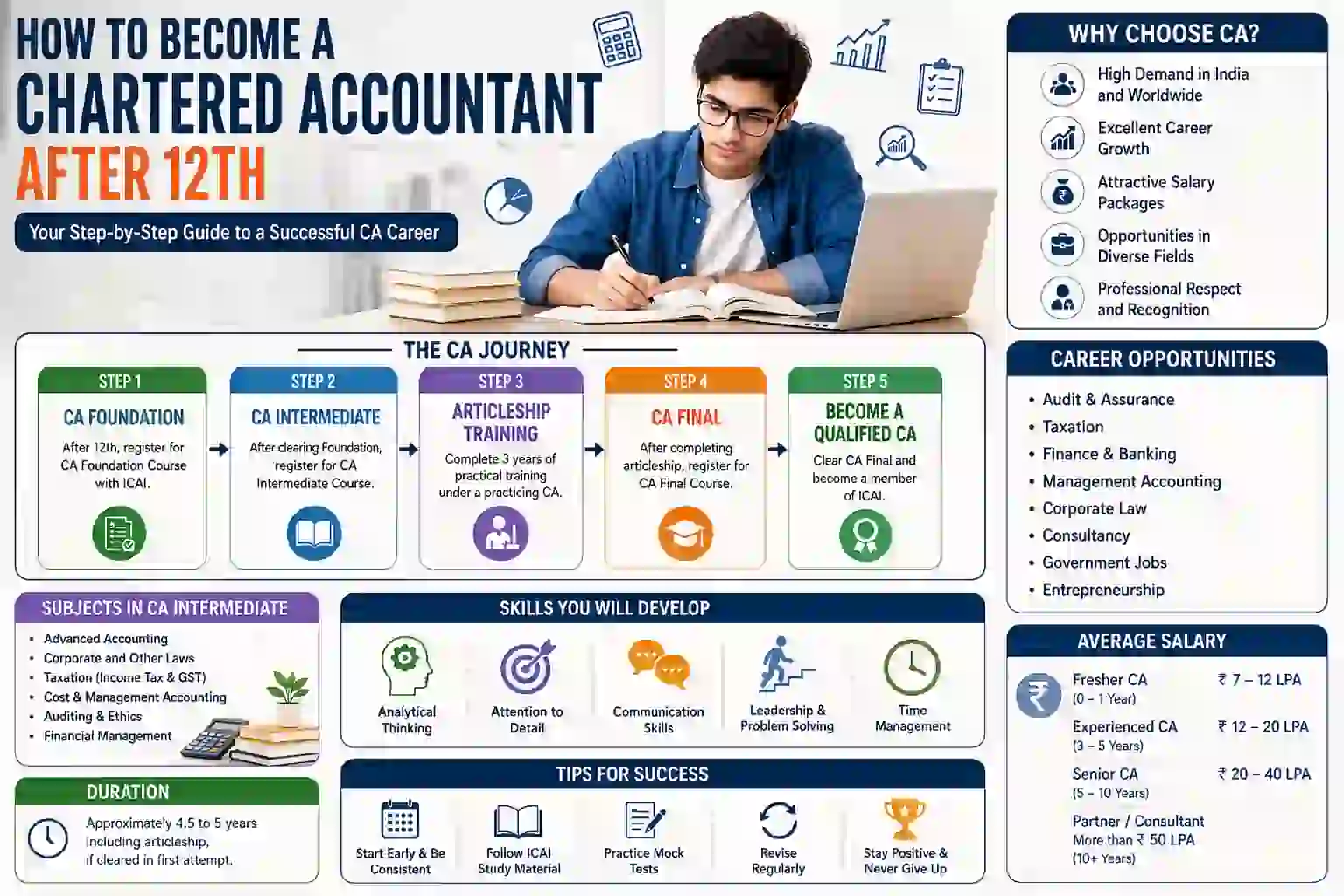
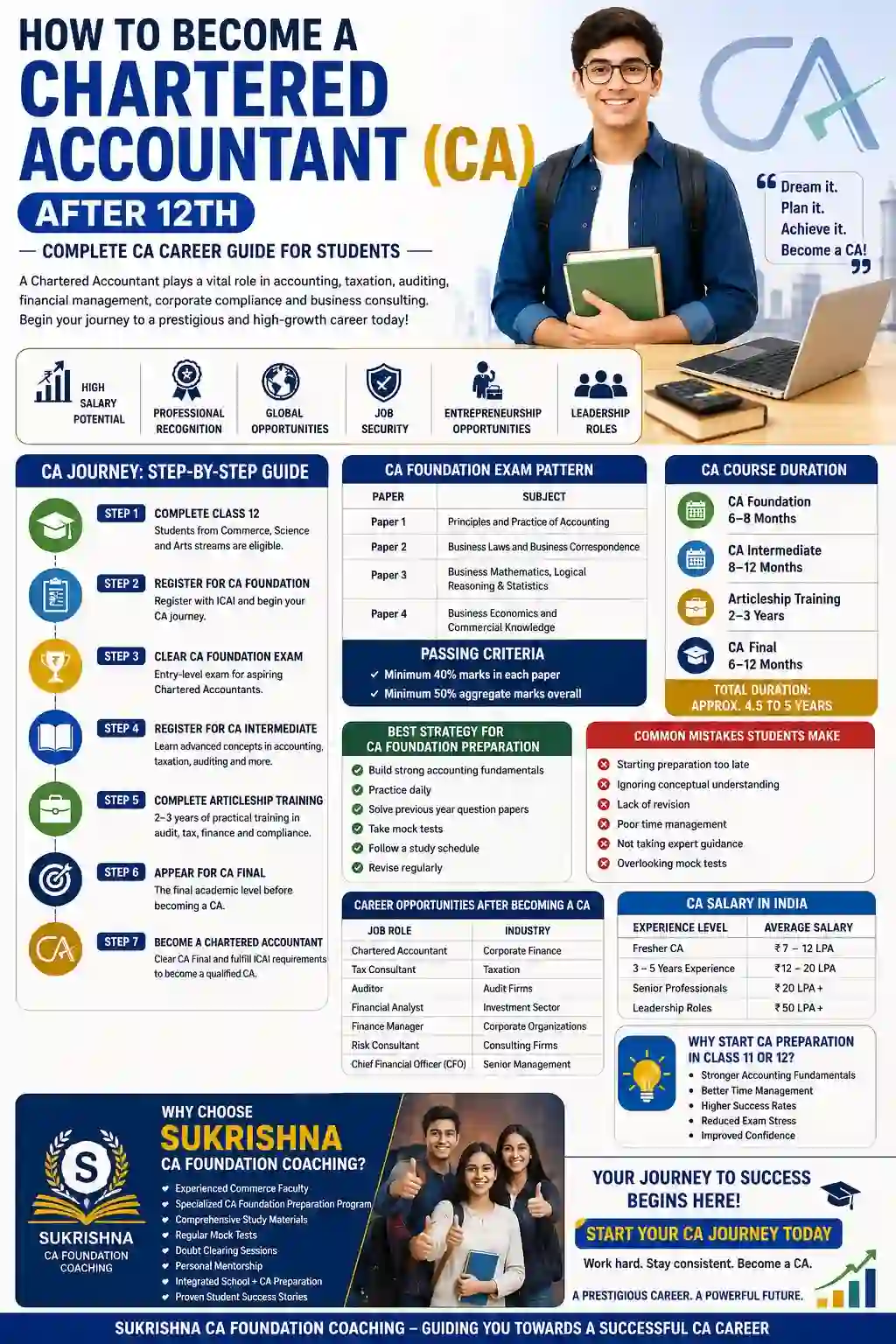
The CA journey consists of several stages. Students must clear each level before moving to the next.
Pass your Class 12 examination from any recognized board.
Preferred streams include:
Commerce
Science
Arts
After passing Class 12, students must register with ICAI for the CA Foundation Course.
This is the first official stage of the Chartered Accountancy course.
Students should register before the ICAI registration deadline for the exam they wish to appear in.
The Foundation course introduces students to the basics of accounting, business law, economics, and quantitative aptitude.
Consistent preparation during this stage is extremely important because it forms the foundation for the entire CA journey.
After qualifying the Foundation examination, students become eligible for the next stage—the CA Intermediate Course.
The Intermediate level is more advanced and requires a deeper understanding of accounting, taxation, costing, auditing, and finance.
(Covered in Part 2.)
The Chartered Accountancy course consists of three major examination levels.
| Stage | Description |
|---|---|
| CA Foundation | Entry Level Examination |
| CA Intermediate | Second Level |
| Articleship Training | Practical Training |
| CA Final | Final Professional Examination |
Each stage is designed to build technical knowledge along with practical skills required in the finance profession.
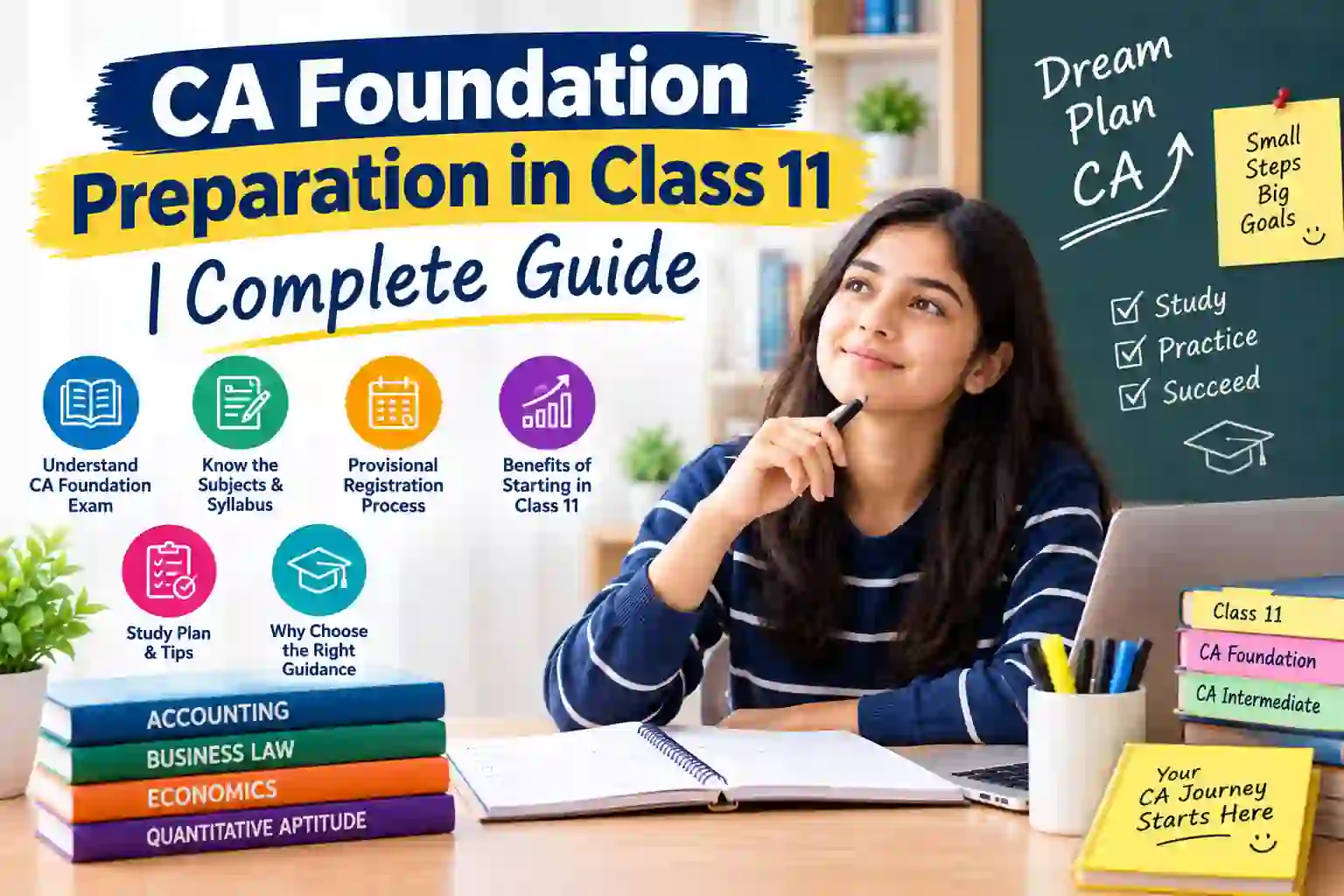
The CA Foundation course is the first milestone for every aspiring Chartered Accountant.
It helps students develop fundamental knowledge of:
Accounting
Business Laws
Economics
Mathematics
Logical Reasoning
Statistics
A strong understanding of these subjects is essential for success in higher CA levels.
The Foundation examination generally includes the following papers:
Accounting
Topics include:
Accounting Principles
Journal Entries
Ledger
Trial Balance
Final Accounts
Depreciation
Business Laws
Students learn:
Indian Contract Act
Business Correspondence
Legal Concepts
Business Ethics
Quantitative Aptitude
Includes:
Mathematics
Statistics
Logical Reasoning
Business Economics
Topics include:
Microeconomics
Macroeconomics
Demand & Supply
National Income
Market Structures
The examination is conducted by ICAI.
Students should regularly check the latest ICAI notifications for:
Exam dates
Registration deadlines
Admit cards
Result announcements
Updated syllabus
Many students believe CA is impossible to clear.
The truth is:
Students who study consistently from the beginning have significantly better chances of clearing the examination.
Read the complete ICAI syllabus before beginning preparation.
Instead of memorizing answers, understand the concepts thoroughly.
Accounting and Mathematics require continuous practice.
Daily revision improves speed and accuracy.
Practicing previous question papers helps students understand:
Question pattern
Difficulty level
Time management
Mock tests improve confidence and exam readiness.
Revision is the key to retaining concepts.
Students should revise every subject multiple times before the examination.
Apart from academic knowledge, successful Chartered Accountants possess several professional skills.
Ability to analyze financial information.
Comfort with numbers and calculations.
Finding financial solutions for businesses.
Explaining financial information clearly.
Handling multiple assignments effectively.
Providing strategic financial advice.
Maintaining honesty and professional integrity.
Many students fail because they repeat common mistakes.
Avoid:
Studying only before exams
Ignoring revision
Skipping mock tests
Weak conceptual understanding
Poor time management
Depending only on coaching without self-study
Consistency is far more important than studying for long hours occasionally.
Choosing the right coaching institute can make your CA journey easier and more structured. Sukrishna Commerce is one of the trusted commerce coaching institutes in Patna, helping students prepare for professional courses like CA Foundation with experienced faculty and a student-focused learning approach.
Experienced Commerce Faculty
Concept-Based Teaching
Regular Mock Tests
Updated Study Material
Doubt-Clearing Sessions
Small Batch Sizes
Personalized Guidance
Proven Track Record in Commerce Education
Convenient Locations Across Patna
Whether you are starting your CA journey after Class 12 or looking for expert guidance, Sukrishna Commerce provides a supportive learning environment to help students build a strong foundation for the CA course.
After successfully clearing the CA Foundation Examination, students move to the next stage of the Chartered Accountancy course. This stage is more advanced and focuses on practical accounting, taxation, auditing, corporate laws, financial management, and strategic decision-making.
Many students find the Intermediate level more challenging than the Foundation because the syllabus is extensive and requires conceptual clarity along with consistent practice. However, with proper planning and disciplined preparation, students can clear this level and move closer to becoming a Chartered Accountant.
In this part, we will discuss the complete journey from CA Intermediate to becoming a qualified Chartered Accountant, including practical training, course duration, fees, salary, and career opportunities.
The CA Intermediate Course is the second level of the Chartered Accountancy program conducted by the Institute of Chartered Accountants of India (ICAI). Students become eligible for this stage after passing the CA Foundation Examination or through other ICAI-approved entry routes.
At this level, students gain in-depth knowledge of accounting standards, taxation, auditing, corporate laws, cost management, and financial reporting.
Unlike the Foundation level, the Intermediate course emphasizes both theoretical concepts and practical applications, preparing students for real-world business and financial challenges.
The exact syllabus may be updated by ICAI from time to time, but the course generally covers the following areas:
Students learn:
Accounting Standards
Company Accounts
Partnership Accounts
Branch Accounts
Financial Statements
Consolidation of Accounts
Topics include:
Companies Act
Business Laws
Corporate Governance
Legal Compliance
Regulatory Framework
One of the most important subjects in CA.
Students study:
Income Tax
GST
Direct Taxes
Indirect Taxes
Tax Planning
Tax Compliance
Topics include:
Cost Accounting
Budgeting
Standard Costing
Marginal Costing
Cost Control Techniques
Students learn:
Audit Procedures
Internal Controls
Audit Reports
Professional Ethics
Standards on Auditing
This subject covers:
Capital Budgeting
Investment Decisions
Risk Management
Working Capital Management
Financial Analysis
The Intermediate examination requires disciplined preparation and conceptual understanding.
Divide the syllabus into manageable sections and allocate time for each subject.
Instead of studying for long hours occasionally, maintain a regular study routine.
Regular revision helps retain concepts and improves confidence before examinations.
Solve:
ICAI Study Material
Practice Manuals
Mock Test Papers
Previous Year Question Papers
Avoid rote memorization. Understand why accounting entries, tax provisions, and audit procedures are applied.
One of the biggest advantages of the CA course is its practical training component, known as Articleship.
During Articleship, students work under the supervision of a practicing Chartered Accountant and gain real-world experience in accounting, auditing, taxation, finance, and compliance.
This practical exposure bridges the gap between classroom learning and professional work.
Articleship provides hands-on experience in:
Statutory Audits
Internal Audits
Income Tax Filing
GST Compliance
TDS Returns
Company Law Compliance
Accounting Software
Financial Reporting
Client Communication
Professional Ethics
Students also develop workplace skills such as teamwork, time management, and problem-solving.
Practical training offers several advantages:
Real corporate exposure
Industry experience
Better understanding of taxation
Improved communication skills
Professional networking
Increased employability
Better interview preparation
Many students receive job offers from organizations where they complete their Articleship.
After completing the required practical training and meeting ICAI eligibility requirements, students appear for the CA Final Examination.
This is the last stage of becoming a Chartered Accountant.
The CA Final syllabus focuses on advanced professional knowledge, strategic decision-making, and financial expertise.
Students study advanced topics such as:
Financial Reporting
Strategic Financial Management
Advanced Auditing
Corporate Laws
Direct Tax Laws
Indirect Tax Laws
Risk Management
Professional Ethics
International Taxation
Corporate Finance
The Final examination is considered one of the toughest stages of the CA journey and requires dedicated preparation.
The duration of the Chartered Accountancy course depends on how quickly students clear each examination.
A student who clears all levels in the first attempt generally completes the course in approximately 4.5 to 5 years, including practical training.
Students taking additional attempts may require more time.
The total cost of the CA course is comparatively affordable when compared to many other professional programs such as MBA or MBBS.
Expenses generally include:
ICAI Registration Fees
Examination Fees
Study Material
Coaching Fees (Optional)
Test Series
Books
Revision Classes
The overall investment varies depending on whether students opt for self-study or join coaching institutes.
Coaching is not compulsory, but many students choose coaching for structured learning, expert guidance, regular tests, and doubt-solving support.
Students who are disciplined and comfortable with self-study can also prepare successfully using ICAI study material and practice resources.
However, coaching can be beneficial for students seeking additional support and a planned preparation strategy.
One of the biggest attractions of the CA profession is the excellent earning potential.
The salary of a Chartered Accountant depends on factors such as:
Skills
Experience
Industry
Company
Location
Professional certifications
| Experience Level | Estimated Annual Salary |
|---|---|
| Fresh CA | ₹7–12 LPA |
| 3–5 Years Experience | ₹12–20 LPA |
| Senior Professionals | ₹20–40 LPA or higher |
| Experienced Consultants / Partners | Can exceed ₹50 LPA depending on role and practice |
Actual salaries vary based on employer, skills, and market conditions.
Qualified Chartered Accountants are hired by:
Big Four Accounting Firms
Banks
Insurance Companies
Financial Institutions
Stock Broking Firms
Investment Companies
Manufacturing Companies
IT Companies
Government Organizations
Public Sector Undertakings (PSUs)
Startups
Multinational Corporations (MNCs)
A Chartered Accountant has diverse career options across multiple industries.
Popular career roles include:
Chartered Accountant
Auditor
Tax Consultant
Financial Analyst
Finance Manager
Internal Auditor
Investment Advisor
GST Consultant
Risk Consultant
Business Consultant
CFO (with experience)
Entrepreneur
Independent Practitioner
Many CAs also establish their own consultancy firms and provide accounting, taxation, auditing, and financial advisory services to businesses.
Apart from private companies, Chartered Accountants are recruited by various government organizations, including:
Public Sector Banks
Comptroller and Auditor General (CAG)
Public Sector Undertakings (PSUs)
Regulatory Bodies
Government Finance Departments
Tax Authorities
These positions often provide attractive salaries, job security, and opportunities for career growth.
Beyond technical knowledge, employers look for professionals who possess:
Strong analytical thinking
Communication skills
Business understanding
Leadership qualities
Ethical decision-making
Problem-solving ability
Attention to detail
Time management
Adaptability to changing regulations
Developing these skills alongside academic preparation significantly enhances career prospects.
Building a successful CA career begins with a strong academic foundation. Sukrishna Commerce helps students prepare confidently for the CA Foundation level through experienced faculty, concept-based teaching, and continuous academic support.
Expert Commerce Faculty
Comprehensive CA Foundation Preparation
Regular Practice Tests & Assessments
Doubt-Clearing Sessions
Updated Study Material
Personalized Mentorship
Small Batch Sizes for Better Learning
Strong Focus on Conceptual Understanding
Multiple Convenient Branches Across Patna
With the right guidance and consistent effort, students can take the first step toward achieving their dream of becoming a Chartered Accountant.
Choosing the Chartered Accountancy (CA) course is not just about earning a professional qualification—it's about building a long-term career in finance, taxation, auditing, and business consulting. As businesses continue to grow and financial regulations become more complex, the demand for skilled Chartered Accountants continues to increase in India and across the world.
If you are determined, disciplined, and willing to work hard, the CA profession offers excellent career growth, financial stability, and opportunities to work with some of the world's leading organizations.
After qualifying as a Chartered Accountant, professionals have numerous career options in both the private and public sectors.
Large companies hire Chartered Accountants to manage:
Financial Reporting
Budget Planning
Internal Controls
Tax Planning
Compliance
Risk Management
Popular industries include:
IT Companies
Manufacturing
E-commerce
Banking
Healthcare
Automobile
Telecom
FMCG
Many newly qualified CAs begin their careers with reputed audit firms.
Responsibilities include:
Statutory Audit
Internal Audit
Tax Audit
Financial Due Diligence
Company Compliance
Advisory Services
Banks recruit Chartered Accountants for positions such as:
Credit Analyst
Finance Manager
Investment Advisor
Treasury Officer
Risk Analyst
Government organizations regularly recruit Chartered Accountants through various recruitment processes.
Career opportunities are available in:
Public Sector Undertakings (PSUs)
Government Banks
Finance Departments
Regulatory Authorities
Tax Departments
Government Audit Offices
Many Chartered Accountants establish their own professional firms and provide services such as:
Income Tax Consultancy
GST Consultancy
Company Registration
Accounting Services
Audit Services
Financial Advisory
Business Registration
Startup Consultancy
Owning a CA practice provides flexibility, independence, and significant income potential.
Indian Chartered Accountants are recognized globally and work in countries such as:
United Arab Emirates (UAE)
Singapore
Canada
Australia
United Kingdom
United States (after meeting applicable local requirements)
Professionals with international accounting certifications and experience often enjoy attractive salary packages.
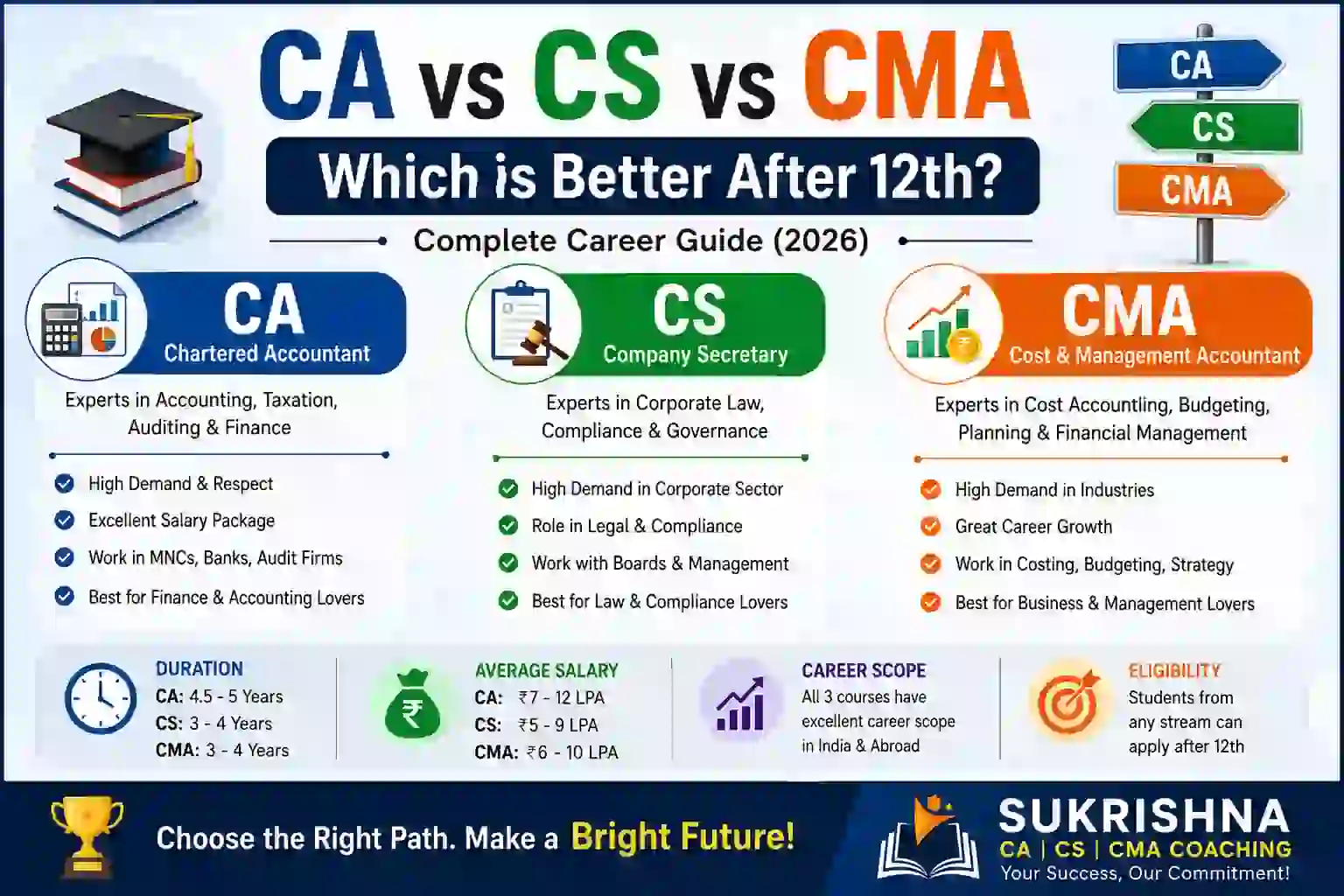
Many Commerce students are confused about choosing between CA, CMA, and CS. Each course offers unique career opportunities based on your interests.
| Feature | CA | CMA | CS |
|---|---|---|---|
| Full Form | Chartered Accountant | Cost & Management Accountant | Company Secretary |
| Main Focus | Accounting, Audit & Taxation | Cost Management & Finance | Corporate Laws & Governance |
| Best For | Finance & Tax Professionals | Cost & Financial Management | Corporate Compliance |
| Career Scope | Very High | High | High |
| Average Salary | Excellent | Very Good | Very Good |
Which course should you choose?
Choose CA if you enjoy accounting, taxation, auditing, and finance.
Choose CMA if you are interested in costing, budgeting, and financial planning.
Choose CS if corporate law, governance, and legal compliance interest you.
Success in Chartered Accountancy depends on more than clearing exams. Employers value professionals who possess both technical expertise and soft skills.
Essential skills include:
Strong analytical thinking
Problem-solving ability
Numerical aptitude
Communication skills
Leadership qualities
Time management
Attention to detail
Decision-making ability
Professional ethics
Continuous learning mindset
Many students dream of clearing all CA levels in their first attempt. While the exams are challenging, success is achievable with the right strategy.
Do not wait until the last few months. Begin studying immediately after registration.
Always prioritize official ICAI study material before referring to additional books.
Maintain consistency rather than studying irregularly.
Presentation plays an important role in professional examinations.
Mock tests help improve:
Accuracy
Speed
Confidence
Time management
Revision strengthens conceptual understanding and reduces exam stress.
Keep track of ICAI announcements regarding:
Registration dates
Exam schedules
Syllabus updates
Result notifications
Many students delay their success due to avoidable mistakes.
Avoid:
Ignoring concepts
Studying only before exams
Skipping revision
Not solving mock tests
Depending entirely on coaching
Poor time management
Lack of discipline
Remember, consistency is the key to success in the CA journey.
A strong foundation is the first step toward becoming a successful Chartered Accountant. Sukrishna Commerce has earned the trust of Commerce students in Patna by providing quality coaching, experienced faculty, and a result-oriented learning environment.
Experienced CA Foundation Faculty
Comprehensive Classroom Programs
Concept-Based Learning
Updated Study Material
Regular Mock Tests
Doubt-Clearing Sessions
Individual Student Attention
Affordable Fee Structure
Multiple Branches Across Patna
Proven Track Record in Commerce Education
Whether your goal is to clear the CA Foundation examination or build a long-term career in finance, Sukrishna Commerce provides the academic support needed to start your journey with confidence.
Yes. Students from Commerce, Science, or Arts streams can register for the CA Foundation course after passing Class 12.
No. Mathematics is not compulsory for pursuing the CA course, although basic numerical skills are beneficial.
The Chartered Accountancy examinations are conducted by the Institute of Chartered Accountants of India (ICAI).
The CA course consists of:
CA Foundation
CA Intermediate
Articleship Training
CA Final
Students who clear all examinations on their first attempt generally complete the course in approximately 4.5 to 5 years, including practical training.
Yes. Science students are eligible to pursue the CA course after Class 12.
Yes. Arts students can also register for the CA Foundation course.
Yes. Chartered Accountancy is one of India's most respected and rewarding professional careers with excellent growth opportunities.
No. Coaching is optional, but many students prefer coaching for structured guidance and regular practice.
Yes. Students can pursue CA alongside or after graduation, subject to ICAI eligibility norms.
Yes. Qualified Chartered Accountants can establish their own practice and offer accounting, auditing, taxation, and financial consultancy services.
A newly qualified Chartered Accountant may earn approximately ₹7–12 LPA, depending on skills, employer, and location.
Commerce is generally preferred because it provides a foundation in accounting and business subjects, though students from all streams are eligible.
The CA course is challenging, but with disciplined preparation, conceptual clarity, and regular practice, students can succeed.
Sukrishna Commerce offers experienced faculty, concept-based teaching, regular mock tests, doubt-solving sessions, and personalized guidance to help students prepare effectively for the CA Foundation examination.
Becoming a Chartered Accountant after 12th is one of the best career choices for students who aspire to excel in accounting, finance, taxation, auditing, and business advisory. Although the journey requires dedication and hard work, the rewards are substantial—high earning potential, global career opportunities, professional respect, and long-term job stability.
The key to success is to begin early, stay consistent, build strong concepts, and seek quality guidance whenever needed. With the right preparation strategy and determination, you can achieve your dream of becoming a Chartered Accountant.
If you're looking for expert guidance to begin your CA journey, Sukrishna Commerce is committed to helping students build a strong foundation through experienced faculty, structured learning, and continuous academic support.




Copyright 2020-26 All Rights Reserved by Sukrishna Commerce Academy. Desgined by Shish Technology




 info@sukrishnacommerce.com
 +91-8051000032















 Download Brochure